MemoVance Pro Official Website › Blog › Five Daggers And A Decimal Comma
Five Daggers And A Decimal Comma
Two rows on this panel carry a percentage, five carry a dagger, and one percentage is punctuated in a way no United States label should be. Learning what each of those marks means is the fastest single improvement anybody can make to how they read a supplement label.
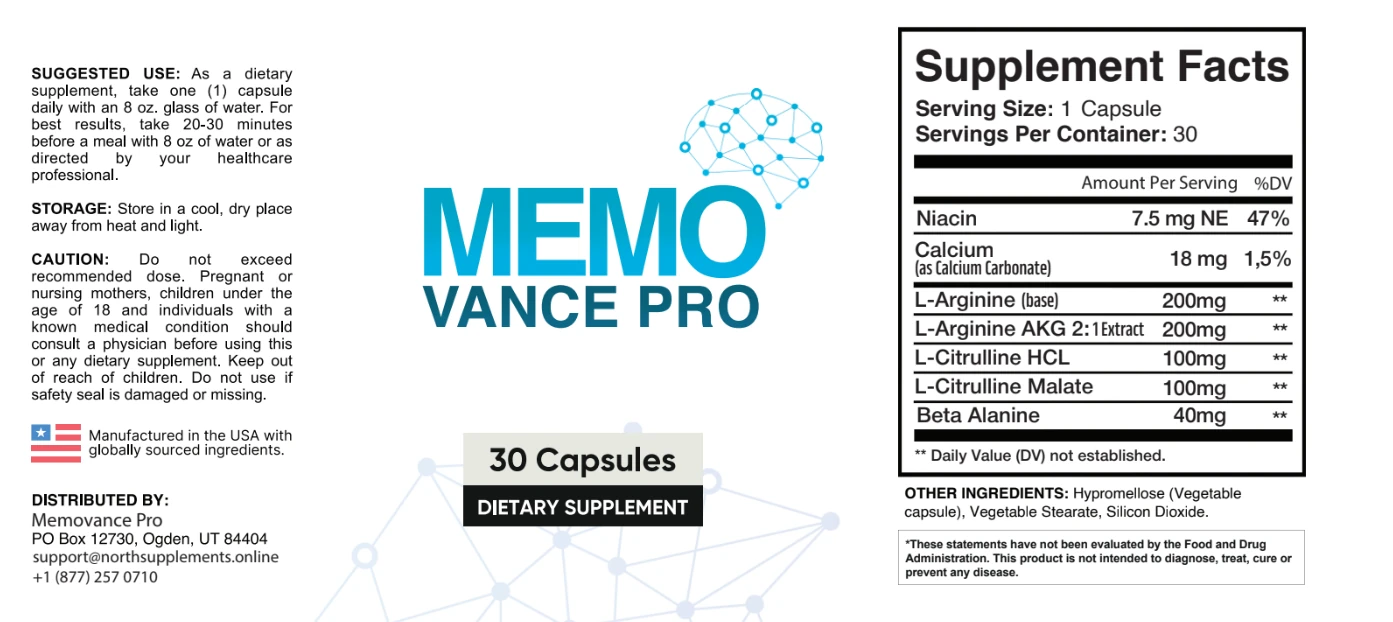
- A percentage is a share of an established Daily Value, which is a nutritional reference and not a therapeutic dose.
- A dagger means no Daily Value exists for that ingredient. It is not a warning and it is not a gap.
- Every amino acid carries a dagger, because free amino acids have no intake reference.
- 47% of 7.5 mg NE implies a Daily Value of about 16 mg NE, which is internally consistent.
- 18 mg of calcium is 1.38% of 1,300 mg and 1.8% of 1,000 mg; the panel prints 1,5%.
- The serving line at the top governs every figure beneath it, and it is the line most often skipped.
Start with the serving line
Every figure on a Supplement Facts panel is per serving, and the serving is defined at the top. That one line decides what the rest of the numbers mean, and it is the line most readers skim past on the way to the ingredients.
On this bottle it reads one capsule, 30 servings per container. That is the simplest case available and it makes every other figure directly readable: 200 mg is 200 mg in the capsule you swallow.
Where a panel declares a two or three capsule serving, every amount on it must be divided before it can be compared with anything, including with another product. A panel showing 600 mg per three-capsule serving and a panel showing 200 mg per capsule are the same product, and the first looks three times stronger on a shelf.
What a percentage is a percentage of
A percentage on a supplement panel is a share of a Daily Value, which is a nutritional reference figure for a population rather than a dose for a person.
That distinction does most of the work in this article. A Daily Value is set around avoiding deficiency and supporting normal function across a population. It is not the amount at which an ingredient has been shown to do something interesting, and the gap between the two can be enormous.
Niacin illustrates it precisely. A Daily Value for niacin is measured in single-figure to low double-figure milligrams. The cardiovascular trial that studied niacin most heavily gave 25,673 adults two grams a day of an extended-release form, which is hundreds of times the reference figure and a completely different proposition.
So a row at 47% of a Daily Value is a real nutritional contribution and nothing more. It is not a small dose of the thing the grams-scale trials studied.
What a dagger means
The dagger is the most misunderstood mark on any supplement panel, and it is entirely innocuous.
It means no Daily Value has been established for that ingredient. Daily Values exist for vitamins, minerals and a handful of macronutrients, because those are the nutrients with recognised intake references. Free amino acids sold as supplement ingredients have no such reference, so there is nothing for a percentage to be a percentage of.
It does not mean the ingredient is unregulated, unusual, experimental or concealed. On this panel all five amino rows carry one, and all five also carry their own printed milligram figure, which is the only thing that actually matters.
The mark to worry about is a different one: a proprietary blend total with no individual amounts beneath it. That is a genuine gap, because nothing under it can be compared with any published trial. This panel does not have one.
| What you see on a panel | What it means | What it does not mean |
|---|---|---|
| A percentage | The amount as a share of an established Daily Value | That the amount is effective, or that the Daily Value is a therapeutic dose |
| A dagger | No Daily Value has been established for this ingredient | That the ingredient is unregulated, unusual or hidden |
| A blend total with no rows | A proprietary blend: only the total is declared | Anything at all about how much of each ingredient is present |
| An extract ratio such as 2:1 | The proportions inside the compound | That the printed weight is all active |
| A standardisation percentage | The share of a named marker compound | That the marker is the thing producing any effect |
Five things that appear on supplement panels. Only the first two appear on this one.
Both percentages on this panel, checked
| Row | Printed | The arithmetic | Reconciles? |
|---|---|---|---|
| Niacin | 7.5 mg NE at 47% | 7.5 divided by 0.47 implies a 16 mg NE Daily Value | Yes, internally consistent |
| Calcium | 18 mg at 1,5% | 18 mg is 1.38% of 1,300 mg and 1.8% of 1,000 mg | Not exactly, on either reference |
| The five amino rows | A dagger each | No Daily Value exists for a free amino acid | Not applicable, and not a gap |
Two percentages and five daggers. Both percentages were checked and one of them does not land cleanly.
The niacin row checks out. Dividing 7.5 by 0.47 gives 15.96, which implies a Daily Value of about 16 mg NE. That is a coherent reference figure and the two printed numbers agree with one another.
This desk requested the National Institutes of Health fact sheet to confirm which reference the manufacturer worked from, and the server answered a script with an access refusal rather than a page. The result is therefore reported as internally consistent rather than as confirmed against a primary source, which is a smaller claim and an honest one.
The calcium row does not land cleanly on either common reference. Eighteen milligrams is 1.38% of 1,300 mg and 1.8% of 1,000 mg, and the panel prints 1,5%. The difference is about half a percentage point on a row carrying eighteen thousandths of a gram, so nothing about a purchase turns on it.
It is noted because an article about reading panels accurately should say when a panel it is reading raises a question, even a trivial one.
Read the MemoVance Pro panel for yourself
Seven rows, two percentages, five daggers and one capsule a day, with 180 days from the date of purchase if the bottle does not match what you expected.
Two bottles $158 · six bottles $294 · 180-day money-back guarantee
Order MemoVance Pro On The Official WebsiteLot MEM-26/ME-2602 · 30 capsules · one swallowed each day
The decimal comma, and what it suggests
The calcium percentage is printed as 1,5% rather than 1.5%, and this website reproduces it with the comma because the job of a transcription is to match the bottle in the reader's hand.
A decimal comma is European convention. United States labelling uses a decimal point. Its appearance on a bottle sold in the United States suggests artwork prepared for, or by, somebody working to more than one market's conventions.
That is an observation rather than an accusation. Artwork is routinely produced by design studios working across markets, and a punctuation convention surviving a market change is the least consequential thing that can go wrong on a label.
It is worth mentioning for one practical reason: a reader who notices it and wonders whether the bottle is genuine now has an answer. The batch page sets out six checks that do address that question.
Five symbols and what each one hides
- A percentage tells you the row is a nutrient with a reference figure, and where it sits against that figure. It says nothing about effect.
- A dagger tells you no reference exists. Read the milligram figure beside it and ignore the mark.
- A blend total tells you the manufacturer has declined to say how much of each ingredient is present, which ends any comparison with published research.
- An extract ratio such as 2:1 tells you the printed weight is the compound rather than the active inside it.
- A standardisation percentage tells you what share of the extract is a named marker compound, which is more useful than a ratio and still not a guarantee of anything.
Those five cover almost everything a supplement panel can do to make itself harder to read. This one uses the first two and none of the other three, which is why every comparison on the ingredients page is possible at all.
A two-minute method for any panel
- Read the serving line and write it down. Everything else is per serving.
- Scan for a blend total. If one is there, stop. Nothing below it can be checked.
- Add every active into one milligram figure. One number, for the whole serving.
- Note which rows carry a percentage. Those are the nutrients; the rest are the formula.
- Check any percentage that looks odd. Divide the amount by the percentage and see whether the implied reference figure is sensible.
- Read the other-ingredients line. The shell decides whether the capsule suits a vegetarian diet, and it is at the bottom where nobody looks.
- Hold the total against the trial doses. Four grams for arginine, six for citrulline, four to six for beta-alanine from the ISSN position stand.
Seven steps, two minutes, and no specialist knowledge. Applied to this bottle they produce one capsule per serving, no blend, 640 mg of amino acids, two nutrient rows, one percentage that reconciles and one that does not quite, a hypromellose shell, and a total comfortably below every threshold in the seventh step.
Applied to the next bottle you pick up they will produce something different, which is the point of learning them.
At 18 mg it is far below the 500 to 1,200 mg used in the levothyroxine interaction studies and the comparison across calcium salts, so it does not raise the timing question that larger calcium rows do. That is the one place on this panel where reading closely produces good news.
Reading a label accurately establishes what is inside a capsule and nothing beyond it. What this one contains is a dietary supplement for healthy adults of 18 and over, offered on cognitive function and mental clarity and on nothing else. Not a medicine, not FDA-approved, not a treatment. Where somebody else has noticed a change in your memory, that belongs with a person who can examine you; a separate article covers it properly.
References
- Landray MJ, Haynes R, Hopewell JC, et al. Effects of extended-release niacin with laropiprant in high-risk patients. N Engl J Med. 2014;371(3):203-12. PMID 25014686. https://pubmed.ncbi.nlm.nih.gov/25014686/
- Javaid A, Mudavath SL. Niacin-induced flushing: Mechanism, pathophysiology, and future perspectives. Arch Biochem Biophys. 2024;761:110163. PMID 39322100. https://pubmed.ncbi.nlm.nih.gov/39322100/
- Singh N, Singh PN, Hershman JM. Effect of calcium carbonate on the absorption of levothyroxine. JAMA. 2000;283(21):2822-5. PMID 10838651. https://pubmed.ncbi.nlm.nih.gov/10838651/
- Zamfirescu I, Carlson HE. Absorption of levothyroxine when coadministered with various calcium formulations. Thyroid. 2011;21(5):483-6. PMID 21595516. https://pubmed.ncbi.nlm.nih.gov/21595516/
- Trexler ET, Smith-Ryan AE, Stout JR, et al. International society of sports nutrition position stand: Beta-Alanine. J Int Soc Sports Nutr. 2015;12:30. PMID 26175657. https://pubmed.ncbi.nlm.nih.gov/26175657/