MemoVance Pro Official Website › How it works
How it worksHow Does MemoVance Pro Work? The Nitric Oxide Pathway
MemoVance Pro works through the nitric oxide pathway, which helps blood vessels relax.
Arginine and citrulline are what the body makes nitric oxide from. Beta-alanine builds carnosine over weeks, and niacin feeds NAD, used in cell energy.
See the amounts on the ingredients page.
The chemistry, the claimed link to thinking, and where each step stands.
The pathway the MemoVance Pro formula is built around
One route, two entry points, and one row that belongs to neither.
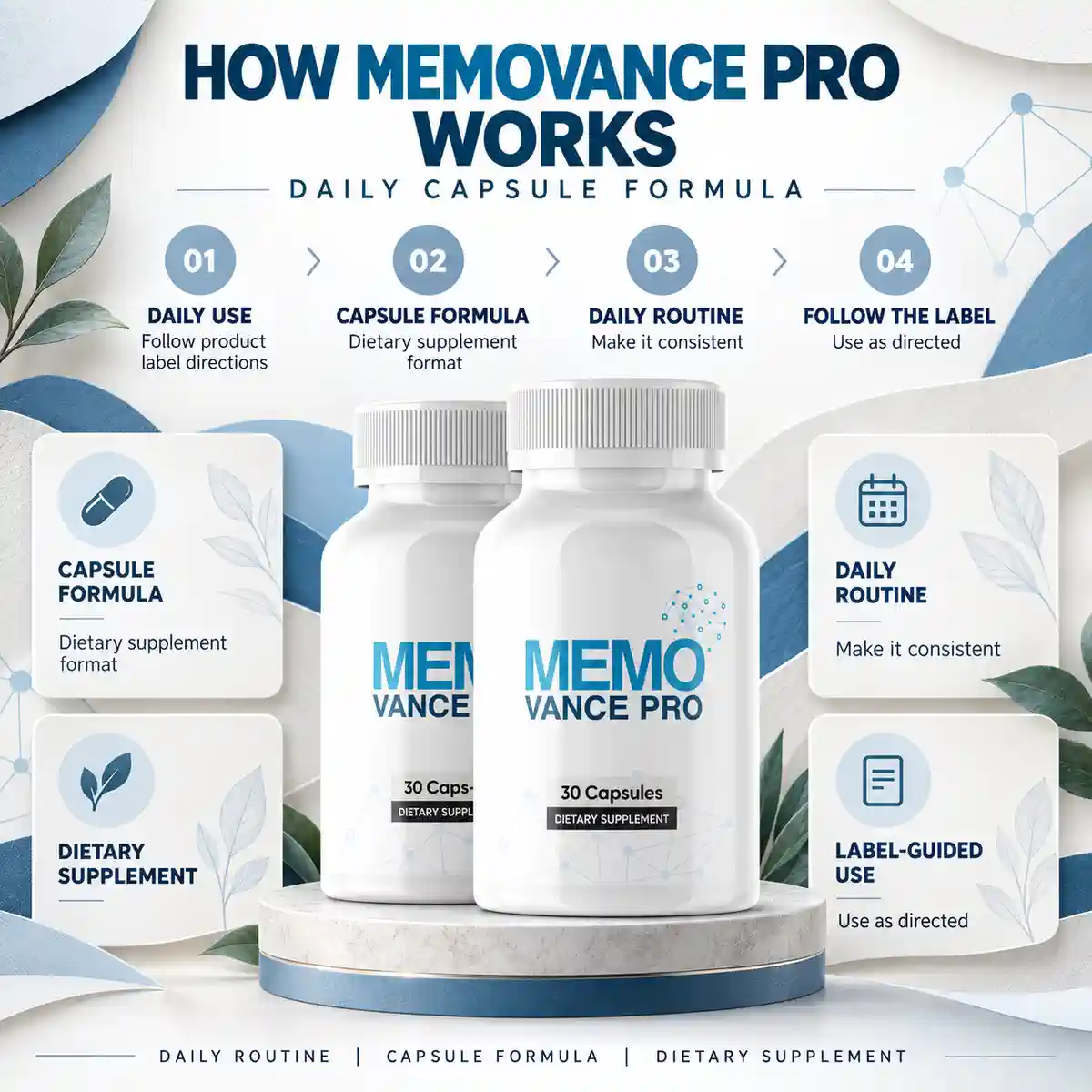
Five of the seven rows feed one chemical route, and naming it makes the rest of this page straightforward. Arginine is the substrate that nitric oxide synthase converts into nitric oxide. Nitric oxide diffuses into the smooth muscle wrapping a blood vessel and tells it to relax. A relaxed vessel carries more blood at a lower pressure.
Citrulline joins the same route one step upstream. Swallowed arginine is largely intercepted by arginase before it reaches the bloodstream; citrulline is not, and the kidney converts it into arginine after it has passed that checkpoint. That is why a citrulline dose raises circulating arginine more dependably than an arginine dose of the same size.
Beta-alanine belongs to a different chemistry altogether. It is the limiting ingredient for carnosine, which accumulates in muscle and brain tissue over weeks of daily intake and acts as a buffer and an antioxidant there.
How MemoVance Pro connects that pathway to thinking
Three separate steps, and where each of them stands.
The argument a nitric oxide formula makes about cognition is a circulatory one, and it has an honest version and a dishonest one. The honest version runs: the brain has no fuel reserve of its own, it depends entirely on continuous perfusion, and the vessels that supply it relax under the same nitric oxide signalling as every other vessel. Anything that supports normal vascular function is therefore adjacent to cognitive function.
The dishonest version compresses that into a promise. It is worth naming the step where the compression happens: from a mechanism that exists, to a supplement dose that engages it, to a measurable change in how somebody thinks. Each of those is a separate claim and each needs its own evidence.
The second step is where the published work is most awkward for this category. Schwedhelm's dose ladder found that only three grams of citrulline twice a day lifted plasma arginine, and the arginine dose-response analysis found nothing below four grams a day. Those are the gateway figures, and everything downstream of them assumes they have been cleared.
The third step has been tested directly, in the one place the literature reaches cognition: a 1.5 g acute dose of inositol-stabilised arginine silicate improved cognitive outcomes in healthy adults. It is a genuine positive result, on a stabilised compound this label does not carry, at seven and a half times this label’s arginine row.
What the niacin row contributes to MemoVance Pro
What the B3 row is doing, and which literature belongs to it.
Niacin is the row with the clearest biochemical job on the panel. It is converted into nicotinamide adenine dinucleotide, the coenzyme that carries electrons through every energy-producing reaction a cell runs. Neurons are metabolically expensive and their demand for that coenzyme is continuous.
That has made the NAD pathway one of the more active areas in cognitive research, though almost all of it uses nicotinamide riboside rather than niacin. Three trials mark out the territory: one in mild cognitive impairment at a gram daily over ten weeks, one published in 2025 at the same daily gram over eight, and one in long COVID at double that.
Those are different compounds at doses between one and two grams. A capsule carrying 7.5 mg NE of niacin sits in a different order of magnitude, and this desk names those trials to show what a B3-pathway cognition study looks like rather than to borrow their findings.
What 7.5 mg NE does do is contribute usefully towards a day’s requirement, which is a modest and real thing. It will not produce the flushing sensation niacin is known for either: the 2024 review of that mechanism describes a response to doses in the hundreds of milligrams.
The second mechanism inside MemoVance Pro, and its timetable
Carnosine, the weeks it takes, and the evidence on both sides.
Beta-alanine works on a clock nothing else on this panel shares. Carnosine is built inside muscle and brain tissue rather than absorbed whole, and the build is slow: the ISSN position stand describes four to six grams a day over four weeks or more before tissue concentrations move.
It is also the row with the most direct cognitive evidence anywhere near this label, which is an odd thing to say about the smallest amount on it. Three results point in its favour and all three used 2.4 grams daily: a randomised study in older adults, an imaging follow-up in sixty to eighty year olds reporting altered fractional anisotropy in two brain structures, and a twenty-eight day trial of executive function in middle age.
Three more point away. Soldiers whose tactical performance improved showed no cognitive change; a fortnight at twelve grams daily was put through simulated operational stress; and six point four grams daily over fourteen weeks shifted neither BDNF nor Stroop scores.
Carnosine supplied directly has the better file. Pooling the histidine dipeptide trials in 2024 produced a delayed recall improvement, and two grams daily over twelve weeks helped the younger half of one trial. Neither asked a body to build the dipeptide from a precursor first. At 40 mg, this row gestures at that literature rather than dosing it.
How far the evidence carries MemoVance Pro
Each step of the mechanism, and whether this capsule clears it.
| Step in the argument | Status | What settles it |
|---|---|---|
| Nitric oxide relaxes blood vessels | Established | Textbook physiology, and the reason the whole category exists |
| Oral citrulline raises circulating arginine | Established, at a dose | Schwedhelm's ladder moved the trough only at 3 g twice a day |
| Oral arginine lowers blood pressure | At 4 g a day and above | The dose-response meta-analysis detected nothing below it |
| This capsule delivers those doses | No | 640 mg of all five amino acids together, against 4 to 12 g of one |
| Beta-alanine raises tissue carnosine | At 4 to 6 g a day over weeks | The ISSN position stand; this row is 40 mg |
| Carnosine itself supports delayed recall | Encouraging, given directly | A 2024 meta-analysis, and a 2 g-a-day carnosine trial |
| Niacin supports normal energy metabolism | Yes, at food-level amounts | 7.5 mg NE is 47% of the Daily Value the panel works from |
The first three rows are physiology and pooled trial data. The fourth is arithmetic on the label in front of you.
Read down that table and the position is clear enough. The mechanism is real, the ingredients are the right ingredients for it, and the amounts are between a twentieth and a hundred-and-twenty-fifth of the amounts that engaged it in published work.
The one row that lands where it should is the niacin, and it lands there because a vitamin requirement is measured in milligrams rather than grams. That is worth saying plainly rather than burying: on a seven-row panel, one row is at a researched amount and it is the least glamorous one on the label.
What is left once the MemoVance Pro mechanism is discounted
Three things that survive the arithmetic.
A supplement that does not reach a trial dose is not therefore inert, and pretending otherwise would be its own kind of dishonesty. Three things remain, and all three are worth the reader’s attention.
The first is the niacin, which contributes 47% of a day’s Daily Value as the panel calculates it. A person whose diet is thin on meat, fish and fortified grains is not being sold nothing by that row.
The second is the routine. One capsule, taken at the same moment each morning, twenty to thirty minutes before a meal, is a structure rather than a chemical. Buyers in the distributor’s own roster describe exactly that: “Daily habit stuck. Reordered before the last bottle.” is the most repeated comment across the eight names published, and the reviews page handles those figures with their limits attached.
The third is that everything above can be checked. A panel with seven printed figures invites the comparison this page has just made. A blend would have made every sentence on this page impossible to write, and a great many products in this category are sold that way.
How MemoVance Pro works: common questions
Does MemoVance Pro increase nitric oxide?
The ingredients are the ones the body makes nitric oxide from, so the pathway is the right one. Whether 640 mg of amino acids engages it is a separate question, and the pharmacokinetic study that answered it needed three grams of citrulline twice a day to move plasma arginine. This desk does not assert that the capsule raises nitric oxide in a person.
How long before MemoVance Pro does anything?
Two mechanisms, two clocks. The vasodilating amino acids act within hours at doses that work, and beta-alanine builds carnosine over four weeks and more. The distributor’s own roster puts the typical wait at 3–4 weeks, and the timeline page sets out what to watch week by week.
Is MemoVance Pro a nootropic?
Not in the sense that word is usually used. The nootropic shelf means bacopa, ginkgo, lion’s mane, citicoline and phosphatidylserine, and this panel carries none of them. It is a nitric oxide amino acid formula sold for cognitive function and mental clarity.
Does the MemoVance Pro mechanism depend on taking it before food?
The suggested use asks for the capsule twenty to thirty minutes before a meal, which is consistent with how amino acids are handled: a protein-heavy meal puts competing amino acids through the same intestinal transporters. The label gives the instruction without explaining it, and the explanation above is this desk’s reading of the pharmacology.
Why does MemoVance Pro include beta-alanine at all?
It is the only row with direct cognitive trial evidence, from a 2.4 g-a-day study in older adults and an imaging follow-up. Forty milligrams is a sixtieth of that dose. The ingredient choice is defensible; the amount is the part worth weighing.
Sources for how MemoVance Pro is said to work
Each study named above, grouped by the row of the panel it belongs to.
- Javaid A, Mudavath SL. Niacin-induced flushing: Mechanism, pathophysiology, and future perspectives. Arch Biochem Biophys. 2024;761:110163. PMID 39322100. https://pubmed.ncbi.nlm.nih.gov/39322100/
- Orr ME, Kotkowski E, Ramirez P, et al. A randomized placebo-controlled trial of nicotinamide riboside in older adults with mild cognitive impairment. Geroscience. 2024;46(1):665-682. PMID 37994989. https://pubmed.ncbi.nlm.nih.gov/37994989/
- Wu CY, Kupferschmid AC, Chen L, et al. Cognitive and Alzheimer's disease biomarker effects of oral nicotinamide riboside (NR) supplementation in older adults with subjective cognitive decline and mild cognitive impairment. Alzheimers Dement (N Y). 2025;11(1):e70023. PMID 39817194. https://pubmed.ncbi.nlm.nih.gov/39817194/
- Wu CY, Reynolds WC, Abril I, et al. Effects of nicotinamide riboside on NAD+ levels, cognition, and symptom recovery in long-COVID: a randomized controlled trial. EClinicalMedicine. 2025;89:103633. PMID 41357333. https://pubmed.ncbi.nlm.nih.gov/41357333/
- Shiraseb F, Asbaghi O, Bagheri R, et al. Effect of l-Arginine Supplementation on Blood Pressure in Adults: A Systematic Review and Dose-Response Meta-analysis of Randomized Clinical Trials. Adv Nutr. 2022;13(4):1226-1242. PMID 34967840. https://pubmed.ncbi.nlm.nih.gov/34967840/
- Gills JL, Campitelli A, Jones M, et al. Acute Inositol-Stabilized Arginine Silicate Improves Cognitive Outcomes in Healthy Adults. Nutrients. 2021;13(12):4272. PMID 34959823. https://pubmed.ncbi.nlm.nih.gov/34959823/
- Schwedhelm E, Maas R, Freese R, et al. Pharmacokinetic and pharmacodynamic properties of oral L-citrulline and L-arginine: impact on nitric oxide metabolism. Br J Clin Pharmacol. 2008;65(1):51-9. PMID 17662090. https://pubmed.ncbi.nlm.nih.gov/17662090/
- Trexler ET, Smith-Ryan AE, Stout JR, et al. International society of sports nutrition position stand: Beta-Alanine. J Int Soc Sports Nutr. 2015;12:30. PMID 26175657. https://pubmed.ncbi.nlm.nih.gov/26175657/
- Ostfeld I, Ben-Zeev T, Zamir A, et al. Role of beta-Alanine Supplementation on Cognitive Function, Mood, and Physical Function in Older Adults; Double-Blind Randomized Controlled Study. Nutrients. 2023;15(4):923. PMID 36839281. https://pubmed.ncbi.nlm.nih.gov/36839281/
- Ostfeld I, Zamir A, Ben-Zeev T, et al. beta-Alanine supplementation improves fractional anisotropy scores in the hippocampus and amygdala in 60-80-year-old men and women. Exp Gerontol. 2024;194:112513. PMID 38971131. https://pubmed.ncbi.nlm.nih.gov/38971131/
- Furst T, Massaro A, Miller C, et al. beta-Alanine supplementation increased physical performance and improved executive function following endurance exercise in middle aged individuals. J Int Soc Sports Nutr. 2018;15(1):32. PMID 29996843. https://pubmed.ncbi.nlm.nih.gov/29996843/
- Hoffman JR, Landau G, Stout JR, et al. beta-alanine supplementation improves tactical performance but not cognitive function in combat soldiers. J Int Soc Sports Nutr. 2014;11(1):15. PMID 24716994. https://pubmed.ncbi.nlm.nih.gov/24716994/
- Varanoske AN, Wells AJ, Boffey D, et al. Effects of High-Dose, Short-Duration beta-Alanine Supplementation on Cognitive Function, Mood, and Circulating Brain-Derived Neurotropic Factor (BDNF) in Recreationally-Active Males Before Simulated Military Operational Stress. J Diet Suppl. 2021;18(2):147-168. PMID 32138563. https://pubmed.ncbi.nlm.nih.gov/32138563/
- Mendonca PT, Dutra YM, Antunes BM, et al. Fourteen weeks of beta-alanine supplementation and HIIT did not improve serum BDNF concentrations and Stroop test performance. Int J Sports Med. 2025;46(5):324-333. PMID 39832765. https://pubmed.ncbi.nlm.nih.gov/39832765/
- Bell SM, Hariharan R, Laud PJ, et al. Histidine-containing dipeptide supplementation improves delayed recall: a systematic review and meta-analysis. Nutr Rev. 2024;82(10):1372-1385. PMID 38013229. https://pubmed.ncbi.nlm.nih.gov/38013229/
- O'Toole TE, Amraotkar AR, Gao H, et al. Carnosine supplementation improves cognitive outcomes in younger participants of the NEAT trial. Neurotherapeutics. 2025;22(2):e00541. PMID 39919936. https://pubmed.ncbi.nlm.nih.gov/39919936/
Order MemoVance Pro knowing exactly what the mechanism is
One capsule a day, seven printed amounts, and 180 days from purchase to decide whether the routine earns its place.
Two bottles $158 · six bottles $294 · 180-day money-back guarantee
Order MemoVance Pro On The Official WebsiteLot MEM-26/ME-2602 · 30 capsules · one swallowed each day