MemoVance Pro Official Website › Ingredients
IngredientsMemoVance Pro Ingredients: The Seven in Each Capsule
Each MemoVance Pro capsule has seven ingredients, each with its own printed amount.
L-arginine and L-arginine AKG are 200 mg each, the two citrulline forms 100 mg each and beta-alanine 40 mg, for 640 mg of amino acids. Niacin 7.5 mg NE and calcium 18 mg complete it.
See the label as printed on the supplement facts page.
Seven rows, seven figures, and the trial dose that sits behind each one.
What is on the MemoVance Pro ingredient panel?
Seven rows, seven figures, and a serving you can count on one hand.
| Row, as the label prints it | Per capsule | % Daily Value |
|---|---|---|
| Niacin | 7.5 mg NE | 47% |
| Calcium (as Calcium Carbonate) | 18 mg | 1,5% |
| L-Arginine (base) | 200 mg | † |
| L-Arginine AKG 2:1 Extract | 200 mg | † |
| L-Citrulline HCL | 100 mg | † |
| L-Citrulline Malate | 100 mg | † |
| Beta Alanine | 40 mg | † |
Serving size one capsule, 30 servings to a bottle. The dagger marks a row for which no Daily Value has been established, which is the case for every amino acid.
How the MemoVance Pro formula divides up by weight
Where the 640 milligrams actually sit.
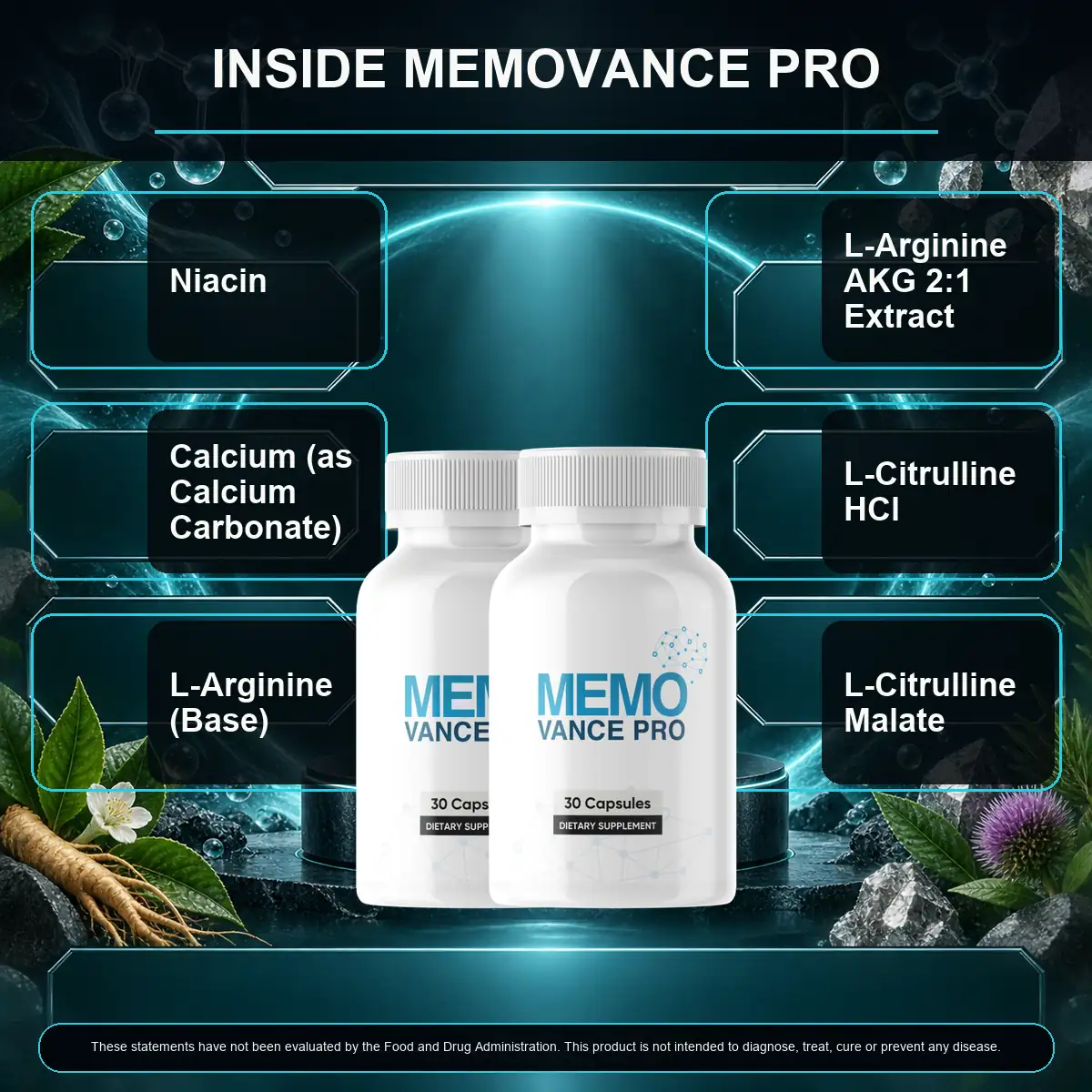
Weight tells the story faster than the alphabetical order the panel uses. The two arginine rows carry 400 mg between them, the two citrulline salts another 200 mg, and beta-alanine 40 mg, which is 640 mg of amino acids out of a capsule that also holds a vitamin, a mineral and three inactive lines.
Put another way, the amino acids are the formula and the other two rows are the nutrition. The seller’s own ingredient graphic, reproduced here, names 6 of the 7 rows and stops before beta-alanine, which the bottle carries at 40 mg.
Every MemoVance Pro ingredient, one row at a time
Each amount, what the ingredient is, and the amount its own research ran on.
Niacin
vitamin B3, as niacinamide or nicotinic acid7.5 mg NE · 47% DVThe one row on this panel at a nutritionally meaningful figure, and the only one carrying a percentage of a Daily Value rather than a dagger. Seven and a half milligrams of niacin equivalents is roughly what a generous portion of chicken breast or tuna supplies, which is the right way to picture it.
Niacin is a precursor to NAD, the coenzyme every cell uses to turn food into usable energy, and the brain is among the hungriest customers for it. That is the honest reason a B3 row belongs in a formula sold for cognitive function, mental clarity. The vitamin’s louder literature sits in the grams: the HPS2-THRIVE trial gave 25,673 adults two grams a day of the extended-release form, two hundred and sixty-six times this row.
Calcium
as calcium carbonate18 mg · 1,5% DVEighteen milligrams of elemental calcium, printed with a European decimal comma the artwork reproduces exactly. In a formula this size the carbonate is doing structural work inside the capsule as much as nutritional work inside the person.
The useful thing about a figure this small is what it rules out. Calcium carbonate is the classic supplement-timing problem because it binds thyroid hormone in the gut: the JAMA study that established it used 1,200 mg of elemental calcium a day, and the follow-up comparing three calcium salts used 500 mg. At 18 mg this row is between twenty-seven and sixty-seven times smaller than either, so a person on levothyroxine can read it and move on.
L-Arginine
free base, the amino acid itself200 mg · largest row on the panelArginine is the direct substrate for nitric oxide synthase, the enzyme that makes nitric oxide, and nitric oxide is what relaxes the lining of a blood vessel. Two hundred milligrams is the joint-largest amount on this label.
The dose literature is unusually clear for an amino acid. A 2022 dose-response meta-analysis in Advances in Nutrition pooled the randomised trials and found blood pressure moved at four grams a day and upward, with nothing detectable below it. A 2026 reassessment using ambulatory monitoring revisited the same question with better measurement.
One study in this neighbourhood looked at thinking rather than circulation: an acute trial of inositol-stabilised arginine silicate reported improved cognitive outcomes in healthy adults at 1.5 g, a different stabilised compound at seven and a half times this row.
L-Arginine AKG
2:1 alpha-ketoglutarate extract200 mg · the second arginineArginine bonded to alpha-ketoglutarate in a two-to-one ratio, which is the form the sports-nutrition shelf standardised on in the 2000s. It exists because the salt was believed to survive first-pass metabolism better than the free base beside it.
Both of the human trials that examined it seriously used twelve grams a day. The eight-week pharmacokinetic and safety study in trained men ran four grams three times daily, and the seven-day blood-flow trial used the same total. Twelve grams is sixty times the 200 mg printed here.
The smaller acute studies are the more interesting comparison, because they failed. Three grams taken acutely did not improve muscular performance, and 3,700 mg per serving changed neither muscle endurance nor blood pressure.
L-Citrulline HCl
the hydrochloride salt100 mg · paired with the malateCitrulline is the indirect route to the same chemistry as arginine. Swallowed arginine is largely stripped out by arginase in the gut wall and the liver; citrulline slips past that, reaches the kidney and is converted to arginine there, which is why it raises circulating arginine more reliably than arginine does.
The study everyone in this category leans on is Schwedhelm's 2008 pharmacokinetic work, and it is worth reading closely rather than citing. It tested a ladder of doses and only the top rung, three grams twice a day, lifted the plasma arginine trough. That is sixty times the citrulline salts on this panel added together.
The lowest citrulline dose with a positive human result found anywhere in this search was 800 mg a day paired with 300 mg of trans-resveratrol, which is still eight times this row and carries a second active the capsule does not contain.
L-Citrulline Malate
citrulline bonded to malic acid100 mg · the fourth amino rowThe same amino acid attached to malic acid, a Krebs-cycle intermediate. Splitting a citrulline allowance across two salts is a formulation decision rather than a nutritional one, and it is the reason this panel prints four amino rows where a simpler label would print two.
Citrulline malate is the pre-workout ingredient proper. The meta-analysis of its effect on repetitions during strength training covers trials that gave six to eight grams forty to sixty minutes before exercise, and the review of perceived exertion and muscle soreness reports eight grams as the commonest dose across its included studies.
Six grams against one hundred milligrams is a sixtyfold gap, and it is the cleanest illustration on the label of why a printed amount is worth more than a long ingredient list.
Beta Alanine
the non-essential amino acid40 mg · smallest row on the panelBeta-alanine has nothing to do with nitric oxide. It is the rate-limiting building block for carnosine, a dipeptide stored in muscle and, in smaller quantities, in brain tissue. Loading it raises muscle carnosine over weeks, not hours.
The International Society of Sports Nutrition position stand asks for four to six grams a day for at least four weeks before carnosine moves, and notes that the tingling sensation people associate with the ingredient is managed by splitting doses of 1.6 g. One point six grams is forty times this row, so nobody will feel anything from this capsule.
The cognition work is the reason a memory formula carries it at all, and it is mixed. Ostfeld's 2023 study in older adults used 2.4 g a day and reported gains, with a hippocampal imaging follow-up at the same dose; fourteen weeks at 6.4 g a day moved neither BDNF nor Stroop performance.
Why MemoVance Pro prints two arginines and two citrullines
Four rows, two amino acids, and what the split does and does not hide.
Four of the seven rows are two amino acids in two forms each, and a reader is entitled to ask why a label would do that rather than print 400 mg of arginine and 200 mg of citrulline on two lines. There are two honest answers and they pull in opposite directions. The generous one is that the forms genuinely differ: arginine alpha-ketoglutarate and the free base have different absorption profiles, and citrulline malate brings a Krebs-cycle acid that citrulline hydrochloride does not. The blunt one is that four rows read as a longer formula than two rows, and a panel is a marketing surface as well as a legal one.
What settles it in the buyer’s favour is that both forms are printed with their own weights. Nothing is concealed by the split, and a reader who wants the combined figure can add the two lines in a second.
One caveat belongs with the arithmetic. An alpha-ketoglutarate extract at a 2:1 ratio is not 200 mg of arginine, and the label prints the extract weight rather than the conversion.
What kind of formula the MemoVance Pro panel describes
Every printed amount held against the amount its own research used.
| Row | On this label | In the research | The multiple |
|---|---|---|---|
| L-Arginine (base) | 200 mg | 4 g a day | 20× |
| L-Arginine AKG 2:1 | 200 mg | 12 g a day | 60× |
| L-Citrulline HCl | 100 mg | 3 g twice a day | 60× |
| L-Citrulline Malate | 100 mg | 6 to 8 g | 60–80× |
| Beta Alanine | 40 mg | 4 to 6 g a day | 100–150× |
| Calcium (carbonate) | 18 mg | 500 to 1,200 mg | 27–67× smaller, usefully |
| Niacin | 7.5 mg NE | A Daily Value in milligrams | At the reference figure |
The fourth column is the whole of the honest analysis on this page, expressed as arithmetic. The last two rows run the other way and are the better news.
This is the section where the comparison belongs, and it is stated here once rather than attached to every paragraph on the site.
Five of the seven rows, adding to 640 mg, are the amino acids of the nitric oxide pathway. That set has a large and legitimate literature, and almost all of it sits in blood pressure and exercise performance. The cardiometabolic review of citrulline and Figueroa's review of citrulline in older adults describe a vascular ingredient, and eight days of either amino acid at eight grams a day did not move a swimmer’s clock.
Read against that literature, every amino row here is between a twentieth and a hundred-and-twenty-fifth of the amount its own trials used. The calcium row is the one figure on the panel that is comfortably where it should be, precisely because it is small, and the niacin row is a food-level amount of a vitamin.
What a buyer of this particular capsule gets is a convenient once-a-day routine with a printed panel and a 180-day window, and the pricing page sets out what that costs.
What else is inside a MemoVance Pro capsule
The shell, the flow agent and the anti-caking agent.
Three inactive lines: hypromellose (vegetable capsule), vegetable stearate, silicon dioxide. All three are ordinary and all three are worth a sentence. Hypromellose is hydroxypropyl methylcellulose, a plant cellulose, and it is the shell itself. That makes the capsule suitable for a vegetarian diet, which a gelatin shell would not. It is the most consequential of the three lines and the one most often skimmed past.
Vegetable stearate is the flow agent that stops powder welding itself to the tooling during encapsulation, and silicon dioxide is the anti-caking agent that keeps the blend loose enough to fill evenly. Neither is an active and neither is unusual. The supplement facts page reproduces the whole panel including this line exactly as the artwork prints it.
What a buyer expecting a nootropic blend finds on MemoVance Pro
The two columns a reader should hold in mind before ordering.
What this label gives you
- Seven rows with a milligram figure against each, printed on the bottle
- A shell made from plant cellulose, so the capsule suits a vegetarian diet
- Niacin at 7.5 mg NE, the only row carrying a real percentage of a Daily Value
- A calcium row small enough to sit clear of the thyroid-timing question entirely
What it asks you to accept
- Four rows out of seven are the same two amino acids in two salts each
- The amino amounts sit far below the figures their own trials ran on
- The set is the nitric oxide group rather than the botanical nootropic group
- An alpha-ketoglutarate extract weight is not the same as an arginine weight
MemoVance Pro ingredient questions, answered
Does MemoVance Pro contain bacopa, ginkgo or lion’s mane?
No. The panel runs niacin, calcium and five amino acids, and no botanical appears on it at all. Any description of this product as a herbal nootropic blend comes from somewhere other than the bottle.
Is there a proprietary blend in MemoVance Pro?
There is not. All 7 rows carry their own milligram figure, which is why the amounts on this page can be compared with published trials at all. The panel page reproduces every row.
How much arginine is in one MemoVance Pro capsule?
Two hundred milligrams of L-arginine base, plus 200 mg of an arginine alpha-ketoglutarate 2:1 extract. The second figure is the weight of the extract rather than of arginine alone, so the total arginine delivered is between 200 mg and 400 mg and the label does not resolve it further.
Is MemoVance Pro suitable for vegetarians?
The shell is hypromellose, a plant cellulose, and the three inactive lines are all plant or mineral derived. On the label as printed the capsule suits a vegetarian diet. The pack carries no certification mark for it, so that is a reading of the other-ingredients line rather than an audited claim.
Why does the MemoVance Pro artwork list six ingredients and the bottle seven?
The seller’s “Inside MemoVance Pro” graphic names 6 rows and leaves beta-alanine out. The graphic is promotional material and the panel is the regulated document, so the bottle governs. The two agree on everything else, which is the more important half of the comparison.
Does MemoVance Pro contain caffeine or any stimulant?
No caffeine line appears on the panel and none appears in the other-ingredients line either. Nothing on this label is a stimulant, which is worth knowing if you intend to take the capsule before breakfast as the suggested use describes.
Sources for the MemoVance Pro ingredient list
Every study named above, in the order the panel lists the row it belongs to.
- Landray MJ, Haynes R, Hopewell JC, et al. Effects of extended-release niacin with laropiprant in high-risk patients. N Engl J Med. 2014;371(3):203-12. PMID 25014686. https://pubmed.ncbi.nlm.nih.gov/25014686/
- Singh N, Singh PN, Hershman JM. Effect of calcium carbonate on the absorption of levothyroxine. JAMA. 2000;283(21):2822-5. PMID 10838651. https://pubmed.ncbi.nlm.nih.gov/10838651/
- Zamfirescu I, Carlson HE. Absorption of levothyroxine when coadministered with various calcium formulations. Thyroid. 2011;21(5):483-6. PMID 21595516. https://pubmed.ncbi.nlm.nih.gov/21595516/
- Shiraseb F, Asbaghi O, Bagheri R, et al. Effect of l-Arginine Supplementation on Blood Pressure in Adults: A Systematic Review and Dose-Response Meta-analysis of Randomized Clinical Trials. Adv Nutr. 2022;13(4):1226-1242. PMID 34967840. https://pubmed.ncbi.nlm.nih.gov/34967840/
- Shi Y, Liu Y, Zhou Z, et al. Reassessment of the effect of oral l-arginine on blood pressure: A systematic review and meta-analysis based on ambulatory blood pressure monitoring. Nitric Oxide. 2026;164:60-68. PMID 42520885. https://pubmed.ncbi.nlm.nih.gov/42520885/
- Greer BK, Jones BT. Acute arginine supplementation fails to improve muscle endurance or affect blood pressure responses to resistance training. J Strength Cond Res. 2011;25(7):1789-94. PMID 21399536. https://pubmed.ncbi.nlm.nih.gov/21399536/
- Gills JL, Campitelli A, Jones M, et al. Acute Inositol-Stabilized Arginine Silicate Improves Cognitive Outcomes in Healthy Adults. Nutrients. 2021;13(12):4272. PMID 34959823. https://pubmed.ncbi.nlm.nih.gov/34959823/
- Campbell B, Roberts M, Kerksick C, et al. Pharmacokinetics, safety, and effects on exercise performance of L-arginine alpha-ketoglutarate in trained adult men. Nutrition. 2006;22(9):872-81. PMID 16928472. https://pubmed.ncbi.nlm.nih.gov/16928472/
- Willoughby DS, Boucher T, Reid J, et al. Effects of 7 days of arginine-alpha-ketoglutarate supplementation on blood flow, plasma L-arginine, nitric oxide metabolites, and asymmetric dimethyl arginine after resistance exercise. Int J Sport Nutr Exerc Metab. 2011;21(4):291-9. PMID 21813912. https://pubmed.ncbi.nlm.nih.gov/21813912/
- Wax B, Kavazis AN, Webb HE, et al. Acute L-arginine alpha ketoglutarate supplementation fails to improve muscular performance in resistance trained and untrained men. J Int Soc Sports Nutr. 2012;9(1):17. PMID 22510253. https://pubmed.ncbi.nlm.nih.gov/22510253/
- Schwedhelm E, Maas R, Freese R, et al. Pharmacokinetic and pharmacodynamic properties of oral L-citrulline and L-arginine: impact on nitric oxide metabolism. Br J Clin Pharmacol. 2008;65(1):51-9. PMID 17662090. https://pubmed.ncbi.nlm.nih.gov/17662090/
- Shirai M, Hiramatsu I, Aoki Y, et al. Oral L-citrulline and Transresveratrol Supplementation Improves Erectile Function in Men With Phosphodiesterase 5 Inhibitors: A Randomized, Double-Blind, Placebo-Controlled Crossover Pilot Study. Sex Med. 2018;6(4):291-296. PMID 30150102. https://pubmed.ncbi.nlm.nih.gov/30150102/
- Varvik FT, Bjornsen T, Gonzalez AM. Acute Effect of Citrulline Malate on Repetition Performance During Strength Training: A Systematic Review and Meta-Analysis. Int J Sport Nutr Exerc Metab. 2021;31(4):350-358. PMID 34010809. https://pubmed.ncbi.nlm.nih.gov/34010809/
- Rhim HC, Kim SJ, Park J, et al. Effect of citrulline on post-exercise rating of perceived exertion, muscle soreness, and blood lactate levels: A systematic review and meta-analysis. J Sport Health Sci. 2020;9(6):553-561. PMID 33308806. https://pubmed.ncbi.nlm.nih.gov/33308806/
- Allerton TD, Proctor DN, Stephens JM, et al. l-Citrulline Supplementation: Impact on Cardiometabolic Health. Nutrients. 2018;10(7):921. PMID 30029482. https://pubmed.ncbi.nlm.nih.gov/30029482/
- Figueroa A, Jaime SJ, Morita M, et al. L-Citrulline Supports Vascular and Muscular Benefits of Exercise Training in Older Adults. Exerc Sport Sci Rev. 2020;48(3):133-139. PMID 32568925. https://pubmed.ncbi.nlm.nih.gov/32568925/
- Esen O, Eser MC, Abdioglu M, et al. Eight Days of L-Citrulline or L-Arginine Supplementation Did Not Improve 200-m and 100-m Swimming Time Trials. Int J Environ Res Public Health. 2022;19(8):4462. PMID 35457330. https://pubmed.ncbi.nlm.nih.gov/35457330/
- Trexler ET, Smith-Ryan AE, Stout JR, et al. International society of sports nutrition position stand: Beta-Alanine. J Int Soc Sports Nutr. 2015;12:30. PMID 26175657. https://pubmed.ncbi.nlm.nih.gov/26175657/
- Ostfeld I, Ben-Zeev T, Zamir A, et al. Role of beta-Alanine Supplementation on Cognitive Function, Mood, and Physical Function in Older Adults; Double-Blind Randomized Controlled Study. Nutrients. 2023;15(4):923. PMID 36839281. https://pubmed.ncbi.nlm.nih.gov/36839281/
- Ostfeld I, Zamir A, Ben-Zeev T, et al. beta-Alanine supplementation improves fractional anisotropy scores in the hippocampus and amygdala in 60-80-year-old men and women. Exp Gerontol. 2024;194:112513. PMID 38971131. https://pubmed.ncbi.nlm.nih.gov/38971131/
- Mendonca PT, Dutra YM, Antunes BM, et al. Fourteen weeks of beta-alanine supplementation and HIIT did not improve serum BDNF concentrations and Stroop test performance. Int J Sports Med. 2025;46(5):324-333. PMID 39832765. https://pubmed.ncbi.nlm.nih.gov/39832765/
Order MemoVance Pro with all seven amounts in front of you
Seven actives, seven printed figures, 30 capsules a bottle and 180 days from purchase to change your mind.
Two bottles $158 · six bottles $294 · 180-day money-back guarantee
Order MemoVance Pro On The Official WebsiteLot MEM-26/ME-2602 · 30 capsules · one swallowed each day