MemoVance Pro Official Website › Supplement Facts
Supplement FactsMemoVance Pro Supplement Facts: The Full Label
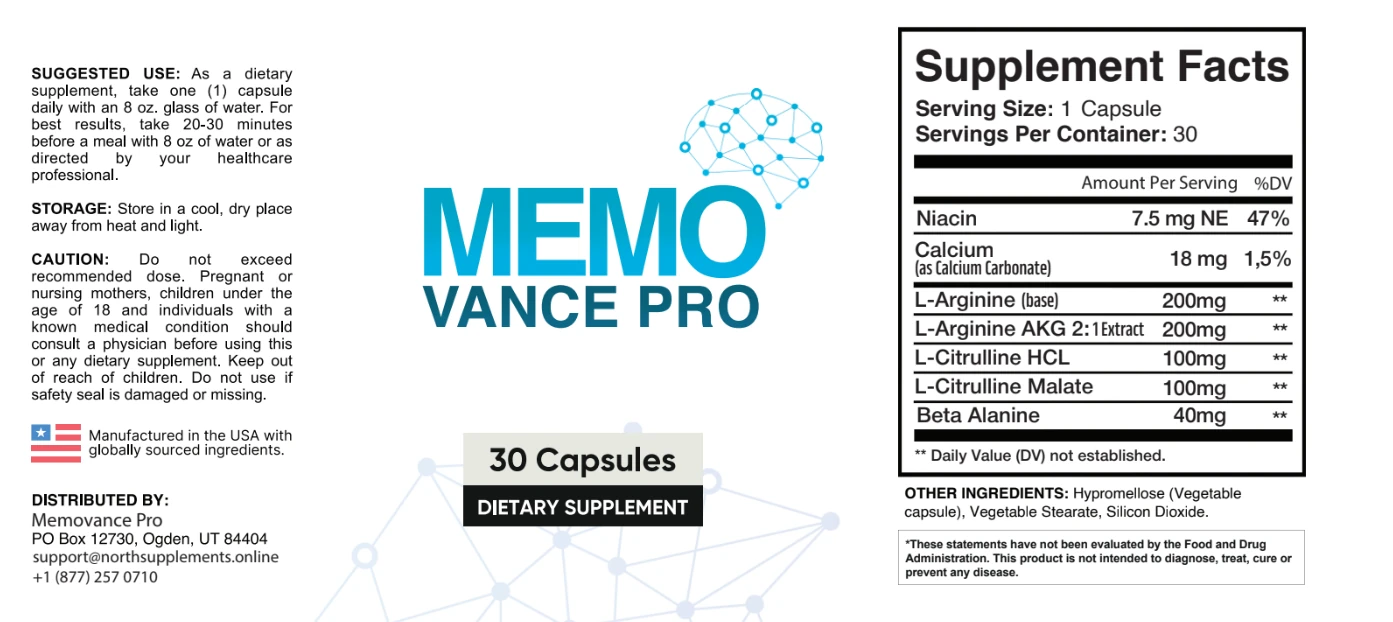
One MemoVance Pro capsule holds seven actives, each with a printed milligram amount.
Niacin 7.5 mg NE, calcium 18 mg, L-arginine 200 mg, L-arginine AKG 200 mg, L-citrulline HCl 100 mg, L-citrulline malate 100 mg and beta-alanine 40 mg. There is no proprietary blend.
Learn what each one is on the ingredients page.
The panel reproduced as the artwork prints it, then every figure on it explained.
The MemoVance Pro panel, exactly as the bottle prints it
Seven rows and two percentages, transcribed rather than summarised.
| Row | Amount per 1 capsule | % Daily Value |
|---|---|---|
| Niacin | 7.5 mg NE | 47% |
| Calcium (as Calcium Carbonate) | 18 mg | 1,5% |
| L-Arginine (base) | 200 mg | † |
| L-Arginine AKG 2:1 Extract | 200 mg | † |
| L-Citrulline HCL | 100 mg | † |
| L-Citrulline Malate | 100 mg | † |
| Beta Alanine | 40 mg | † |
Serving size 1 capsule. Servings per container 30. The calcium percentage is reproduced with the decimal comma the artwork uses.
What one MemoVance Pro serving actually is
One capsule, thirty servings, and the arithmetic that follows from it.
A serving here is one capsule, which makes this label easier to read than most in the category. Where a panel declares a two or three capsule serving, every figure on it has to be divided before it can be compared with anything, and a good many buyers never do that division.
Because a bottle holds 30 servings and the suggested use asks for one a day, a bottle is a calendar month to the day. That single fact does more work than it looks: it makes a pack size legible at a glance, and the pricing page turns it into a cost a day without any guesswork.
Adding the five amino rows gives 640 mg, which is the figure worth carrying around. Two-fifths of it is arginine base, another two-fifths the arginine AKG extract, and the rest splits between the citrulline salts and beta-alanine.
The two MemoVance Pro rows carrying a Daily Value
Both percentages checked, and what each one implies.
| Row | Printed | What the percentage implies | Does it reconcile? |
|---|---|---|---|
| Niacin | 7.5 mg NE at 47% | A Daily Value of about 16 mg NE, since 7.5 divided by 0.47 is 15.96 | Yes. The two figures are internally consistent. |
| Calcium | 18 mg at 1,5% | 18 mg is 1.38% of a 1,300 mg Daily Value and 1.8% of a 1,000 mg one | Not exactly. The printed figure sits between the two. |
This arithmetic is done once, here. It is not repeated elsewhere on the site.
Two rows on this panel carry a percentage and five carry a dagger, so these are the only two figures on the label that can be checked against a reference amount at all.
The niacin row checks out. Forty-seven per cent of 7.5 mg NE implies a Daily Value of roughly 16 mg NE, and that is a coherent number for a niacin reference. This desk requested the National Institutes of Health fact sheet to confirm which reference the manufacturer used and the server answered a script with HTTP 403, so the figure is reported as consistent rather than as confirmed against a primary source.
The calcium row does not reconcile cleanly against either common reference. Eighteen milligrams is 1.38% of 1,300 mg and 1.8% of 1,000 mg, and the panel prints 1,5%. The difference is a rounding of the order of half a per cent on a row carrying eighteen thousandths of a gram, so nothing about a buyer’s decision turns on it. It is noted because a page that transcribes a panel exactly should say when the transcription raises a question.
The comma is the artwork’s own. European labelling uses a decimal comma where United States labelling uses a point, and its presence on a bottle sold in the United States suggests artwork prepared for more than one market.
Why five MemoVance Pro rows show a dagger instead of a percentage
What the mark means, and why it is not a gap.
The dagger is the standard mark for an ingredient with no established Daily Value, and it appears against all five amino acid rows: L-Arginine (base), L-Arginine AKG 2:1 Extract, L-Citrulline HCL, L-Citrulline Malate and Beta Alanine.
It is not a warning and it is not an omission. Daily Values exist for nutrients with a recognised intake reference, which means vitamins, minerals and a handful of macronutrients. Free amino acids sold as supplement ingredients have no such reference, so there is nothing for a percentage to be a percentage of.
What matters is that the milligram figure is printed anyway. A panel is allowed to group ingredients into a proprietary blend and declare only the total, and that is what a large part of this category does. This one does not, which is the single reason every comparison on this website is possible.
So the dagger rows are the interesting rows. They carry no reference amount, but they carry their own weight, and the ingredients page sets each one beside the amount its own published trials used.
The MemoVance Pro other-ingredients line
Three lines, and the one that decides who the capsule suits.
- Hypromellose (vegetable capsule). Hydroxypropyl methylcellulose, a plant cellulose, and the shell itself. It is the reason the capsule suits a vegetarian diet where a gelatin shell would not.
- Vegetable stearate. The flow agent that keeps powder moving through encapsulation machinery rather than welding itself to the tooling. Without something in this role fill weights drift.
- Silicon dioxide. The anti-caking agent, which keeps the blend loose enough to fill each capsule evenly. Both of these are ordinary and both appear on a large share of the shelf.
Three lines, and on a seven-row panel that is a meaningful fraction of the document. The shell line is the one worth reading twice, because it is the one that changes who can take the product.
There is no colour, no sweetener, no flavouring and no preservative here, which follows from the format rather than from any virtue: a capsule is swallowed whole and needs none of them. A gummy version of the same formula would carry four or five additional lines for exactly that reason.
Where the MemoVance Pro artwork and the seller’s graphic agree
What each source names, and which one settles it.
| Source | Names | Status |
|---|---|---|
| The Supplement Facts panel on the bottle | All 7 rows with amounts | The regulated document. This governs. |
| The seller's “Inside MemoVance Pro” graphic | 6 of the 7, beta-alanine aside | Promotional artwork. It corroborates the panel. |
| The seller's sales page copy | No ingredient at all | Names the two claims and leaves the formula to the label. |
Three sources, one of which is the legal document and two of which are marketing.
A three-way comparison usually turns up a contradiction. This one turns up agreement, which is worth saying because it is the reverse of what a sceptical reader expects.
The seller’s ingredient graphic runs niacin, calcium, L-arginine base, L-arginine AKG 2:1, L-citrulline HCl and L-citrulline malate. Every one of those appears on the panel at the amount the panel gives. The graphic stops at 6 and the bottle adds beta-alanine at 40 mg, the smallest row on the label.
Where marketing artwork names fewer ingredients than the panel, the panel is the document that counts and the shorter list is simply a design decision. The failure mode worth worrying about is the opposite one, where a graphic names something the panel never mentions, and that is not what happens here.
The sales page is the outlier, and it is the reason this product is often described as an undisclosed blend. It names no ingredient. The bottle names seven with a figure against each, and the batch page sets out how to confirm the one in your hand matches.
How to check the MemoVance Pro panel against the bottle you received
Five checks, in the order that catches a problem soonest.
Count the rows
Seven, between the serving line and the dagger footnote. A bottle showing six or eight is not the formula this website describes, and +1 (302) 200-3480 should hear about it.
Check the serving line first
It should read one capsule, 30 servings per container. Every other figure on the panel depends on that line, and a change there changes all seven.
Add the five amino rows
200 plus 200 plus 100 plus 100 plus 40 gives 640 mg. If the sum comes out differently, the formula has been revised and this page is describing an older run.
Read the other-ingredients line
Hypromellose first. A shell described as gelatin on a bottle you were sold as a vegetable capsule is a genuine discrepancy rather than a printing variation.
Find the lot code on the base
This batch is MEM-26/ME-2602. Lot codes change between production runs, so a different code is normal. It is the number the order desk needs if anything else on the bottle looks wrong.
What a MemoVance Pro panel cannot tell you
Four questions a panel leaves open, named once.
A printed panel is the best document a supplement buyer gets, and it still leaves four questions open. Naming them here is the point of this section, and they are not repeated anywhere else on the site.
It does not certify that the capsule contains what the panel says. A label is a declaration by the manufacturer; an assay is a measurement by a laboratory. The testing page reads every seal on this pack one at a time and reports which of them speaks to that question.
It does not convert an extract weight into an active weight. The arginine AKG row is 200 mg of a 2:1 extract, and how much of that 200 mg is arginine depends on a specification the label does not carry.
It does not say anything about absorption. Two hundred milligrams swallowed is not 200 mg delivered, and for arginine specifically the gap is the whole reason citrulline appears on the same panel. Schwedhelm's pharmacokinetic work is the study that measured it.
And it says nothing about whether the amounts do anything. That question is answered by trials of each ingredient, which this website cites throughout at the doses they actually used: four grams a day and above for arginine, six to eight grams for citrulline malate, and four to six grams for beta-alanine.
Sources for this MemoVance Pro panel page
The trials behind the amounts named in the closing section.
- Schwedhelm E, Maas R, Freese R, et al. Pharmacokinetic and pharmacodynamic properties of oral L-citrulline and L-arginine: impact on nitric oxide metabolism. Br J Clin Pharmacol. 2008;65(1):51-9. PMID 17662090. https://pubmed.ncbi.nlm.nih.gov/17662090/
- Shiraseb F, Asbaghi O, Bagheri R, et al. Effect of l-Arginine Supplementation on Blood Pressure in Adults: A Systematic Review and Dose-Response Meta-analysis of Randomized Clinical Trials. Adv Nutr. 2022;13(4):1226-1242. PMID 34967840. https://pubmed.ncbi.nlm.nih.gov/34967840/
- Varvik FT, Bjornsen T, Gonzalez AM. Acute Effect of Citrulline Malate on Repetition Performance During Strength Training: A Systematic Review and Meta-Analysis. Int J Sport Nutr Exerc Metab. 2021;31(4):350-358. PMID 34010809. https://pubmed.ncbi.nlm.nih.gov/34010809/
- Trexler ET, Smith-Ryan AE, Stout JR, et al. International society of sports nutrition position stand: Beta-Alanine. J Int Soc Sports Nutr. 2015;12:30. PMID 26175657. https://pubmed.ncbi.nlm.nih.gov/26175657/
- Landray MJ, Haynes R, Hopewell JC, et al. Effects of extended-release niacin with laropiprant in high-risk patients. N Engl J Med. 2014;371(3):203-12. PMID 25014686. https://pubmed.ncbi.nlm.nih.gov/25014686/
- Singh N, Singh PN, Hershman JM. Effect of calcium carbonate on the absorption of levothyroxine. JAMA. 2000;283(21):2822-5. PMID 10838651. https://pubmed.ncbi.nlm.nih.gov/10838651/
Order MemoVance Pro with the panel in front of you
Seven rows, seven printed figures, one capsule a day and 180 days from purchase to change your mind.
Two bottles $158 · six bottles $294 · 180-day money-back guarantee
Order MemoVance Pro On The Official WebsiteLot MEM-26/ME-2602 · 30 capsules · one swallowed each day